
|
.gif) |
| |
|
 |
|
|
|
| |
|
| |
|
| |
Before selecting an investment, ask yourself
these simple but essential questions:
- Is the investment easy to understand?
- Is there a good chance of making money?
- Is there a ready market should I need to sell in a hurry?
- Is the investment relatively inexpensive to buy, hold and sell?
Next, understand the three rules of risk:
- Don't risk more than you can afford to lose
- Consider the odds
- Don't risk a lot for a little
Financial planning is about assisting people at all levels of income
to achieve their short term and long term goals. Its objective is
to accumulate enough to provide for long term financial goals, such
as a college education for your children or a comfortable retirement
for yourself. The average person may be confused or unsure how best
to achieve this. Unsurprising, given the range of financial solutions
and options available. But it's not all that difficult, so let's see
how you can better your prospects of successful financial planning.
This is the Golden Rule of investments:
Remember that the higher the return you hope to make, the greater
the risk you take.
Risk and reward are invariably linked. While you might be tempted
to avoid risk altogether, be aware that doing so could give you lower
returns. Perhaps better to choose a level of risk that you are comfortable
with and match it to your investment needs.
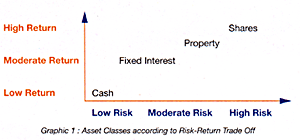
Some people are willing to take on more
risk than others. You should think about the risk level that you are
comfortable with before deciding on the investment and approach that
best suits you.
Over the long term, inflation is a major
issue to contend with and be aware of. As prices rise, the same amount
of money will buy less and less each year. This means that unless
the return on your money is at par with inflation, the value of your
investment will actually be falling. For instance, if the inflation
rate for the year is 3% and your investment vehicle generates a return
of 5%, then you have only really earned 2% return in today's dollars.
A short term investment time frame can
directly affect your returns and the risk associated to some investment
options - especially if you take into consideration transactions costs
and the time you have to recover these costs.
As such, in the short term cash can be seen as a 'safer' option because
its returns are fairly steady, whereas equities will be deemed riskier
as share prices can rise or fall sharply, making it hard to anticipate
or know what your return will be. Thus, if short term risk is a concern
for you, consider investing into other investment instruments such
as cash or fixed interest.
However be cautious as over the long term, cash could become relatively
riskier than equities due to inflation and it's subsequent erosion
of purchasing power while equities could potentially have outpaced
inflation. Also, a longer time frame allows an investor to ride out
the volatility of equities.
It is important to think about how long
your money will be invested for, when deciding where to invest as
this will directly affect the type of investment instrument you choose
and it's risk factor. If you will need your money soon, you may want
to protect it by investing more in lower risk areas. However, over
a longer period, short term ups and downs tend to be smoothed out,
and you may want to consider investment instruments with returns that
will help combat the effects of inflation.
This is the key to managing risk. While
the price of each investment option, i.e. cash, fixed interest, unit
trust, property and shares, will rise and fall, it is unusual for
each option to move in the same direction at the same time. As such
spreading your money across these areas, otherwise known as diversification,
may help enhance the overall return of your investment as a poor result
in one area can be balanced by a good performance of another.
Sound, conscientious financial planning is about taking charge of
one's financial life as opposed to getting along in life. Nevertheless,
research by Brinson, Singer and Breebower* , reveals that asset allocation
plays a major role in long term investment success, and contributes
to approximately 91 percent of the investment result.
*Gary P. Brinson, Brian D. Singer and Gilbert L. Beebower, "Determinants
of Portfolio Performance II: An Update, Financial Analysts Journal,
May/June 1991."
The best way to combat inflation is to
invest in any investment vehicles which usually produce higher returns
over time. Some people may brush off a few extra percent in returns
as not worth the additional risk. Over time, however, a little can
mean a lot.
Take for example, the difference between a 6% and 8% return on an
investment of RM50,000. After five years, the difference would amount
to RM6,555. But over 20 years, the difference would have grown to
over RM72,691 - that's more than the amount of the original investment!
Dollar-cost averaging is a technique widely
practiced in the unit trust industry. It involves investing a fixed
amount at a fixed interval, such as monthly, quarterly, half-yearly
or yearly, regardless of what goes on in the stock market. When fund
prices are higher, your regular additional investment buys fewer units.
But when prices are lower, this same amount of money allows you to
accumulate more units. If the stock market rises over time, you could
eventually end up with units that are worth far more then the original
prices you paid.
This strategy also allows you to avoid timing the market and gives
you both the courage and discipline to keep investing - especially
if you do not want to miss out entirely on a bull run or be burnt
by a severe market correction.
Enlisting the help of professional Unit
Trust consultants can be worth more than a cursory thought. The job
of these people is to follow the behaviour or direction of global
markets in order to anticipate trends and be positioned to make timely
investment decisions on your behalf that best suit your financial
needs and objectives. They have the time, information and expertise
to guard your financial house and protect your well-earned portfolio
from other potential financial problems. More often than not also,
these Unit Trust consultants are backed with years of experience.
Having these Unit Trust Consultant looking after your money could
be useful for you in the long run. |
|
|

.gif)
.gif)
.gif)
.gif)







.gif)
.gif)
.gif)
.gif)